Stake your PDEXand help secure Polkadex
Stake your PDEX to secure the Polkadex network and receive staking rewards each era.
Runtime 392 and your stake
Runtime 392 is live: bonded PDEX is now held instead of locked. Wallets show it as reserved. Your total balance does not change and you do not need to do anything: the team switches affected stashes right after the upgrade, at no cost, so payouts keep working. Keep 1 PDEX free in your account.
Validators: rotate your session keys once, sign session.setKeys with your stash account, and check your bond is still at least 100 PDEX. New keys take effect two sessions later (4 to 8 hours); your old keys keep working until then. Release notes
Staking through Nova Wallet? Nova removes Polkadex from its Staking tab on 25 October. Your PDEX stays staked. To stake, unstake or claim rewards, open explorer.polkadex.ee/stake, which also works inside the Nova Wallet browser. Step-by-step guide for Nova Wallet
New to Polkadex? Create a Polkadex wallet
Total Nominators
PDEX Staked
Active Validators
How does it work?
As a proof of stake (PoS) blockchain, the Polkadex network incentivizes token holders to secure the network via PDEX staking.
Nominators delegate their PDEX to validators who run the network on devices distributed around the world. Validators, who keep the network running and ensure it remains secure, earn daily PDEX rewards and they distribute them proportionately among their respective nominators.
Become a Nominator by delegating your PDEX
Benefits
APY 7.95%
The easiest way to get daily PDEX rewards
Choose a set of validators you trust
Get daily rewards paid out by your validator
Become a Validator
Benefits
Average APY 7.95%
Maximize your rewards
Run a validator node
Get nominations
Charge commissions from your nominators
Earn PDEX rewards for keeping the Polkadex network secure
Staking PDEX means earning rewards for directly contributing to the security and decentralization of the Polkadex network. Through staking, PDEX holders are incentivized to behave in honest ways.
Frequently Asked Questions
Ask in the Polkadex Discord server and the official Telegram channel
Nominators and validators are the participants in the Polkadex staking subsystem. A validator runs 24/7 nodes that validate blocks and keep the network running. A nominator plays a more passive role and is tasked with selecting ‘good’ validators (validators that act in an honest manner) and staking their PDEX with their trusted validators.
When staking PDEX, it is recommended to make two accounts: a controller account and a stash account. The stash account should have the large majority of your funds and its seed phrase should be stored offline (e.g. on a piece of paper kept somewhere safe and away from others) as a cold wallet. The controller account will allow you to stake/unstake your stash’s PDEX but won’t let you transfer PDEX away from your stash. With this setup, the most an attacker will be able to do is to unstake your PDEX, but they will not be able to transfer or steal any PDEX from your stash. You can keep the controller account online in your browser extension as a hot wallet, however, you should still keep the seed phrase as secure as possible.
Using controller and stash accounts when staking makes your PDEX at stake infinitely more secure.
APR or annual percentage rate is the rate at which your PDEX is expected to grow for a year, while APY or annual percentage yield is the rate at which your PDEX is expected to grow for a year with compounding returns. If you select ‘Increase the amount at stake’ for the destination of your staking rewards, you will essentially compound your staking returns and earn PDEX at a higher rate.
There are a handful of forces that affect the overall annual rates of staking rewards.
PDEX is an inflationary asset: new PDEX is issued only through staking rewards. The current total supply is shown live on the Tokenomics page, from the Polkadex Explorer. Nominators select which validators they want to stake with and split each validator’s staking rewards. While validators all split similar amounts of PDEX per day as a reward for securing the network, not all validators have the same PDEX in backing or the same number of backers. The lower the number of total stake per active validator, the higher its APR will be.
Validator commissions also play a part as some validators may charge a higher commission than others, therefore reducing the overall return that nominators may receive from different validators depending on their total commission. Also, since validators are able to charge a commission, they tend to also benefit from higher return rates than nominators do.
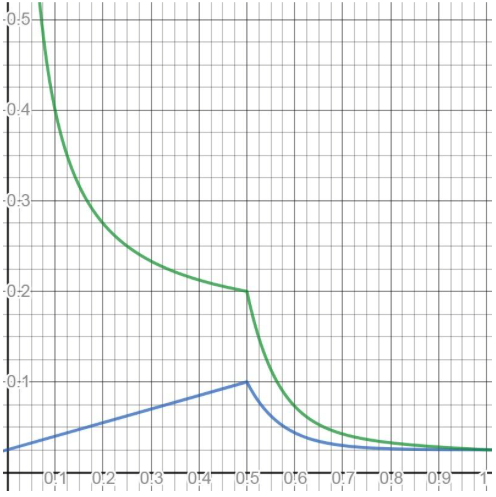
Since inflation is correlated with staking, the overall amount of PDEX being staked also affects APR. In this chart (where the x axis represents the total staked amount and the y axis a percentage, the blue line represents inflation rate while the green is staking APR) you can see how the rate of inflation grows until>50% of PDEX are at stake. 50% PDEX at stake from the total PDEX supply is the ‘ideal’ staked amount. While the total amount of PDEX staked will fluctuate, the chart below illustrates the impact that the total staked amount and the inflation rate will have on the APR.
Interested in becoming a validator? Check out the ‘how to run a validator on Polkadex’ guide on Github (or in the Polkadex Docs)
When you stake PDEX as a nominator, there are many criteria to evaluate your nominated validators by. It is important that you trust your validators and that you have clear channels of communications with them. Validators set their own commission rate, which may be higher or lower depending on your chosen validators. A validator’s commission will impact your total returns. Many validators will generate different expected annual returns based on a number of factors (see question #3). Validators are also generally expected to trigger reward payouts for their nominators (nominators can do so too) and they are expected to do so on a regular basis. Based on your preferences, you may choose a validator who triggers payouts every day at a certain time, or you may choose a validator with a more irregular payout schedule if regular payments aren’t high on your list of concerns. The Polkadot.js/apps interface, staking provider partners, and other community-built tools allow for filtering and sorting of validators based on certain parameters or criteria. However, the final decision of which validators, as well as how many, to nominate comes down to your preferences as a nominator in the process.
Rewards are made available daily but reward payouts have to be triggered by a small on-chain transaction each time they are distributed.
Rewards are distributed directly on the network. As far as timelines and responsibilities go, the short answer is it depends on the validator. It is customary for validators to trigger daily payouts on behalf of their nominators. However, you may find that, as a nominator, you can also trigger reward payouts from your nominated validators to your staking accounts.
Stakers are free to unbond their PDEX and stop staking whenever. It is important to note that there is a 28 day unbonding period in which the unbonding PDEX is locked without earning daily staking rewards before it becomes transferable.
For example, validators who maintain nodes with 24/7 uptime and regularly trigger reward payouts will generally be rewarded with higher PDEX return rates, whereas validators who voluntarily or involuntarily act against the common good of the network (e.g. not maintaining their nodes up to date, charging excessive commission rates) will generally earn lower rewards and may even be slashed.
Slashing is part of what keeps the Polkadex network running securely.
Polkadex, like other Substrate-based networks (including Polkadot), uses a nominated Proof of Stake (nPoS) consensus mechanism. In nPOS networks, the security of the blockchain as a whole is the responsibility of a group of Validators who are nominated by the rest of the stakers in the network (Nominators) to make and validate blocks.
Slashing penalizes network participants who are actively nominating a Validator that does something ‘bad’. Slashing incentivizes nominators to ensure they only vote for Validators they ‘trust’ won’t do something bad in order to keep their own stake safe, thus securing the network as a whole. In this scenario, Nominators only stake with trusted Validators because if Validators do something wrong, their Nominators’ staked PDEX could be slashed.
However, slashing is extremely rare. If a slashing event does happen, the slashed amounts are usually minor. As an example, if a Validator (who is supposed to be online and validating blocks 24/7) goes offline for over 4 hours a slashing could happen. However, in this case, the slashing event would only take place if at least 10% of the network’s Validators are also offline simultaneously. Since the Polkadex network is quite large already, if a handful of Validators go offline, there won’t be any issues. However, if, say, over 10% of Validators were to go offline at the same time, each of those Validators and their Nominators would get 1% of their staked PDEX slashed. The slashing percentage increases in correlation with higher percentages of offline Validators. Therefore, if 50% of the network’s Validators went offline, their stakes would be slashed 7%. 7% is the maximum slashing penalty in this scenario.
Rest assured, Polkadex has never had a slashing event. Polkadot has had 2 slashing events so far with the first being overturned by the governance council and the second resulting in the culpable Validator paying their Nominators back for their slashed DOT.
Follow along as we ship
We post an update every two weeks: upgrade progress, plan changes and validator news. Pick your channel.